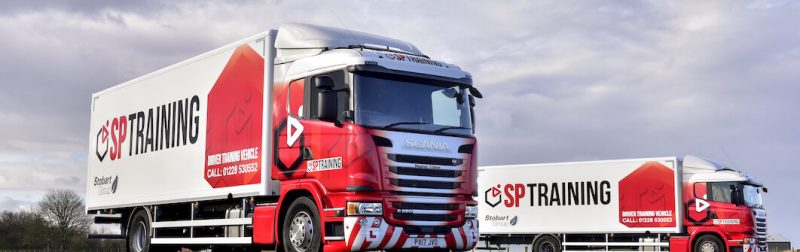
The first thing you need to drive a HGV or large vehicle on the roads in the United Kingdom is the correct licence category. You need to ensure your licence has the correct entitlement to legally drive a particular type of vehicle.
HGV licence categories explained
HGV / LGV Category ‘C+E’ (Class 1)
C+E covers any vehicle over 7.5 tonnes that has a detachable or separate trailer. Cat C+E licences can now be taken straight from having your car licence. You are no longer required to have passed your Cat C (Class 2) licence. The C+E category is for larger articulated vehicles mainly used for long distance haulage going both national and international routes.
An Articulated lorry exceeding 7500kg Cat C+E
HGV licence categories explained
HGV / LGV Category ‘C’ (Class 2)
Cat C is for vehicles that have a rigid based body that is over 7.5 tonnes providing the vehicle is all one unit. You are also allowed a trailer of up to 750kg but not exceeding your maximum authorised mass (MAM).
A Rigid lorry exceeding 7500kg Cat C
HGV licence categories explained
Category C1
C1 is for driving any goods vehicle that weighs more than 3.5 tonnes and is below 7.5 tonnes. If you had your driving licence before 1997 in the UK, you will have automatically have this entitlement on your licence. After 1997 you will need to take a test. C1 also allows you to tow a trailer up to 750kg but not exceeding your maximum authorised mass (MAM).
vehicles that exceed 3500kg but do not exceed 7500kg cat C1
Category C1+E
The Category ‘C1+E’ is the same as above but gives you the ability to tow a trailer exceeding 750kg but the combined weight must not exceed 12,000kg ‘C1’ vehicle.
vehicles that do exceed 7500kg and can tow a trailer exceeding 750kg cat C1+E
HGV licence categories explained – Useful Information
‘MAM’ Maximum authorised mass
Maximum authorised mass (MAM) means the weight of a vehicle or trailer including the maximum load that can be carried safely when it’s being used on the road. This is also known as gross vehicle weight (GVW) or permissible maximum weight.
It will be listed in the owner’s manual and is normally shown on a plate or sticker fitted to the vehicle.
The plate or sticker may also show a gross train weight (GTW), also sometimes called gross combination weight (GCW). This is the total weight of the tractor unit plus trailer plus load.
Unladen Weight
The unladen weight of any vehicle is the weight of the vehicle when it’s not carrying any passengers, goods, or other items. It includes the body and all parts normally used with the vehicle or trailer when it’s used on a road.
It doesn’t include the weight of Fuel, Batteries in an electric vehicle – unless it’s a mobility scooter or powered wheelchair.
Down-Plating
A vehicle can be down-plated if it is unlikely to be used at its potential maximum weight, the lower weight would then be displayed on the vehicle’s plate or sticker.