
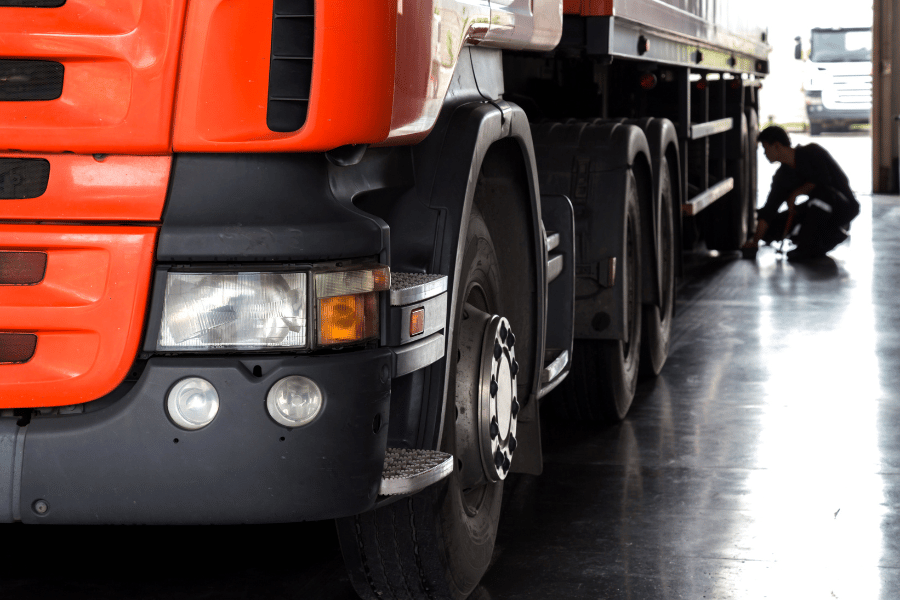
HGV daily walk around checks: One of the most important duties of a professional driver is to perform daily walk-around checks. Each day you must ensure that the vehicle is safe to drive and take out onto public roads. You also need to make sure that your load is still secure and will not move during transit.
Changes to how we now do daily walk around checks
In the dark ages before technology, HGV drivers has to fill out a defect report booklet. Defect books are somewhat a thing of the past and most companies now use an app on their phone, pda or other in order to complete their checks. Vehicle walk around apps will ask you to enter the details of the vehicle such as the registration number, mileage and so on.
Once you have entered the details you will then need to walk around your truck whilst completing the defect report on the app. If you get your work via an app on your phone or using a company pda you probably wont be able to continue your daily work until you have done your walk around.
Whilst apps have pretty much taken over walk around checks your company will still have them in each truck. As with anything digital you cannot always guarantee they will work properly or go offline etc.
HGV Daily walk around checks 2023

Carrying out HGV Vehicle Checks
Guidance from the DVSA shows all the checks required to ensure an HGV truck is safe to drive on the roads of Britain this includes checks inside and outside the vehicle see guidance below.
Vehicle checks inside and outside a HGV
Lights and indicators
Check:
- all lights and indicators are working correctly
- all lenses are fitted, clean and the right colour
- stop lamps come on when you apply the service brake and go out when you release it
- marker lights are fitted and work
Fuel and oil leaks
Check that the fuel filler cap is fitted correctly.
Turn on the engine and check underneath the vehicle for any fuel or oil leaks.
Battery security and conditions
Check that your battery is:
- secure HGV daily walk around checks
- in good condition
- not leaking
Diesel exhaust fluid (AdBlue)
Check that your diesel vehicle has enough AdBlue diesel exhaust fluid and top up if necessary.
Excessive engine exhaust smoke
Check that the exhaust does not emit an excessive amount of smoke.
Security of body and wings
Check that:
- all fastening devices work
- cab doors and trailer doors are secure when closed
- body panels on tractor or trailer are secure and not likely to fall off
- landing legs (if fitted) are secure and not likely to fall off while driving
- side guards and rear under-run guards are fitted if required and that they’re not insecure or damaged
Spray suppression
If spray suppression flaps are required, check that they are:
- fitted
- secure
- not damaged
- not clogged with mud or debris
Tyres and wheel fixing
Check that:
- the tyres and wheels are secure
- the tyres have a tread depth of at least 1mm
- the tyres are inflated correctly
- there are no deep cuts in the tyre’s sidewall
- there is no cord visible anywhere on the tyre
- all the wheel nuts are tight enough – you can check if wheel nut indicators (if fitted) have moved to do this
- there are no objects or debris trapped between the twin wheels
Brake lines and trailer parking brake
Check that:
- couplings are free from debris and are in the right place
- there are no leaks
- there is no damage or wear to the brake lines
- the parking brake for the trailer works
After the initial brake test, leave the engine running so pressure can build up. This will make it easier to hear any leaks as you carry out the rest of the walk-around check.
Electrical connections
Check each connection and make sure that all:
- visible wiring is insulated
- visible wiring is not likely to get caught or damaged
- all electrical trailer couplings are connected securely
- all electrical switches work correctly
Coupling security
Check that your vehicle is securely attached to your trailer and that the:
- trailer is located correctly in the fifth wheel or coupling
- secondary locking devices are in the correct position
Security of load
Check that the load does not move and is not likely to move.
Make sure you use the right type of load securing system for the load.
If you are dissatisfied with how the load is secured or hot stable it it, request that the person on charge of vehicle safety checks it out:
- get a competent person to assess it
- reload or re-secure it if necessary
Number plate
Check that the number plate is not:
- broken or incomplete
- incorrect or spaced incorrectly
- dirty HGV daily walk around checks
- faded
- covered over by anything
Reflectors
Check that the reflectors (including side reflectors) are not:
- missing
- broken
- insecure
- fitted incorrectly
- the wrong colour
- obscured by dirt or other objects
Markings and warning plates
Check that the vehicle’s markings (including conspicuity markings) are:
- the right colour
- visible
- securely fastened
- not obscured by dirt or other objects
Mirrors and glass
Check that the windscreen is not:
- cracked
- scratched
- discoloured
Ensure that the windscreen and front side windows are not excessively tinted.
Check that all mirrors are in place and not:
- damaged or missing glass
- obscured
- insecure
If a camera system is used instead of a mirror, check that it works and the view is correct.
Windscreen wipers and washers
Make sure the windscreen wipers work. Check that they are not:
- missing
- damaged or worn
Make sure the windscreen washer is working.
Front view
Check that no objects get in the way of your front view.
As a general rule, there should be nothing in the swept area of the windscreen wipers.
Some official stickers and road safety items, such as operators licence discs, are permitted as long as they do not significantly obstruct your view of the road.
Dashboard warning lights and gauges
Check that all of these are working correctly:
- instruments
- gauges
- warning lights – including the engine warning, emissions system, anti-lock braking system (ABS), and electronic braking system (EBS)
Steering
Check that the steering wheel:
- moves properly and that the power-assisted steering works correctly
- has no excessive play
- does not jam
Check that there’s no excessive lift or movement in the steering column.
Horn HGV daily walk around checks
Check that the horn works and is easily accessible from the driver’s seat.
Brakes and air build-up
Check that:
- the air builds up correctly and the warning system works
- there are no air leaks
- the footwell is clear
- the service brake operates both the tractor and trailer brakes
- the parking brake for the tractor works
- the service brake pedal does not have excessive side play or missing loose or incomplete anti-slip tread
Height marker
Check that the correct vehicle height is displayed on the cab’s vehicle height marker. Remember: The height of your vehicle can change if the fifth wheel is adjusted or the trailer is loaded, unloaded or reloaded.
Seatbelts
Check that the seatbelts:
- do not have any cuts, damage, or fraying that may stop them from working
- stay secure when you plug them in
- retract against you when fitted, and fully retract when you take them off
What to do if you get a defect during a journey?
If you notice a defect while travelling, find a safe place to stop, report the defect, if the defect is dangerous, get it repaired immediately before continuing your journey.
Should you continue driving with a defect that is dangerous, you might find yourself landing a hefty fine or even a prison sentence.
Read more from our blog
